Advanced Design Research and Future Product Innovation

Research-driven capabilities for exploring emerging opportunities, developing future scenarios and generating innovative product directions

My professional and academic research increasingly combines industrial design, artificial intelligence, data science, statistical analysis, strategic foresight and advanced innovation methods.

These capabilities make it possible to extend the traditional product development process: not only designing new products, but also understanding how technologies, behaviours, markets and design languages may evolve, and translating this knowledge into concrete innovation opportunities.

The following nine areas can be used independently or combined according to the needs of each client, sector or project.

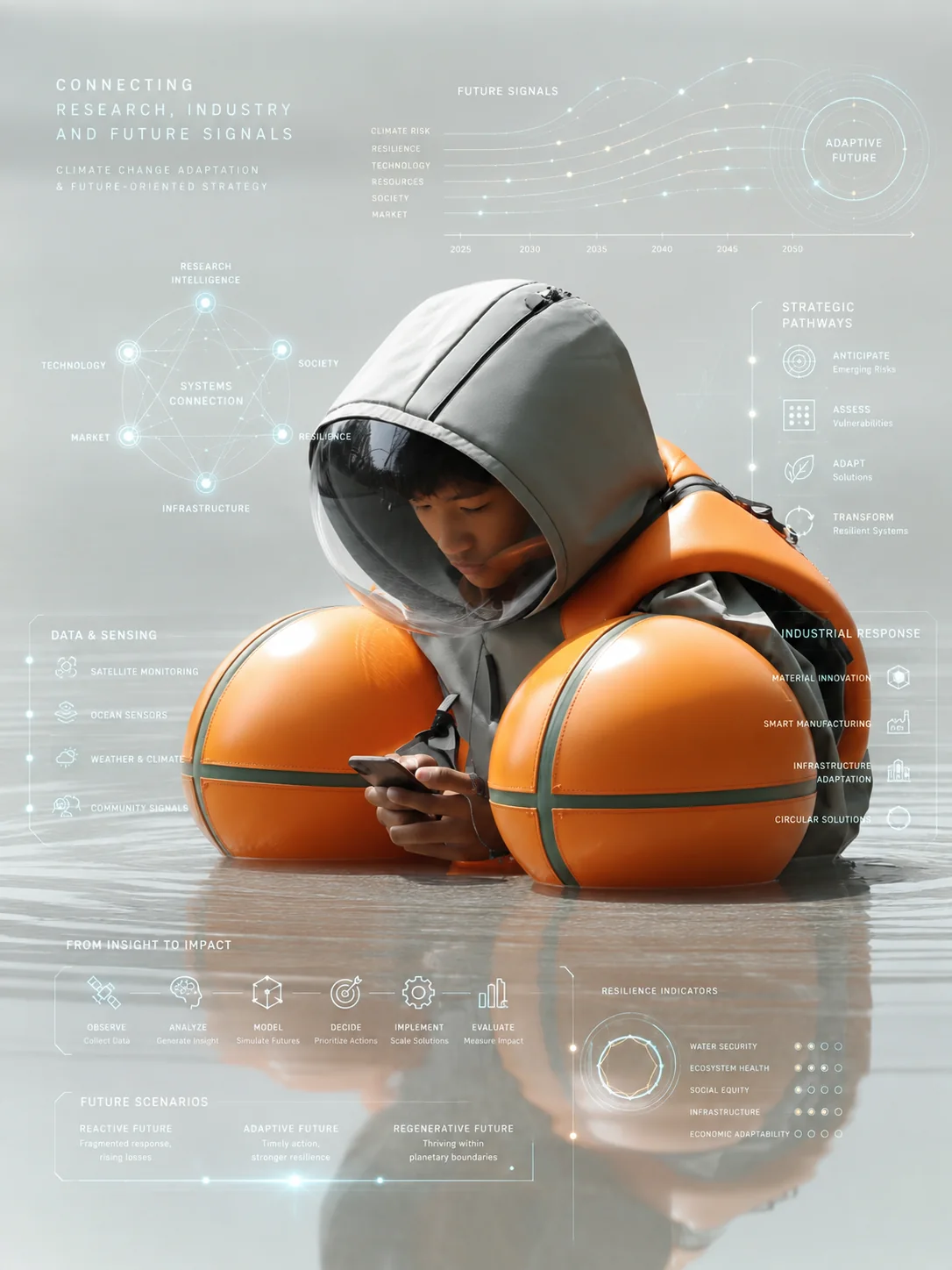
Why design the Future?

Expanding the Scope of Innovation

The integration of these capabilities could help you to expand your offer of future innovation, providing clients with advanced, research-based and data-informed services. It could also support the identification of new product opportunities before traditional design development begins.

Anticipating Change

By combining European research and Chinese capabilities, you could strengthen your ability to anticipate technological, social and market transformations. This connection would create a stronger foundation for interpreting change and developing relevant future-oriented strategies.

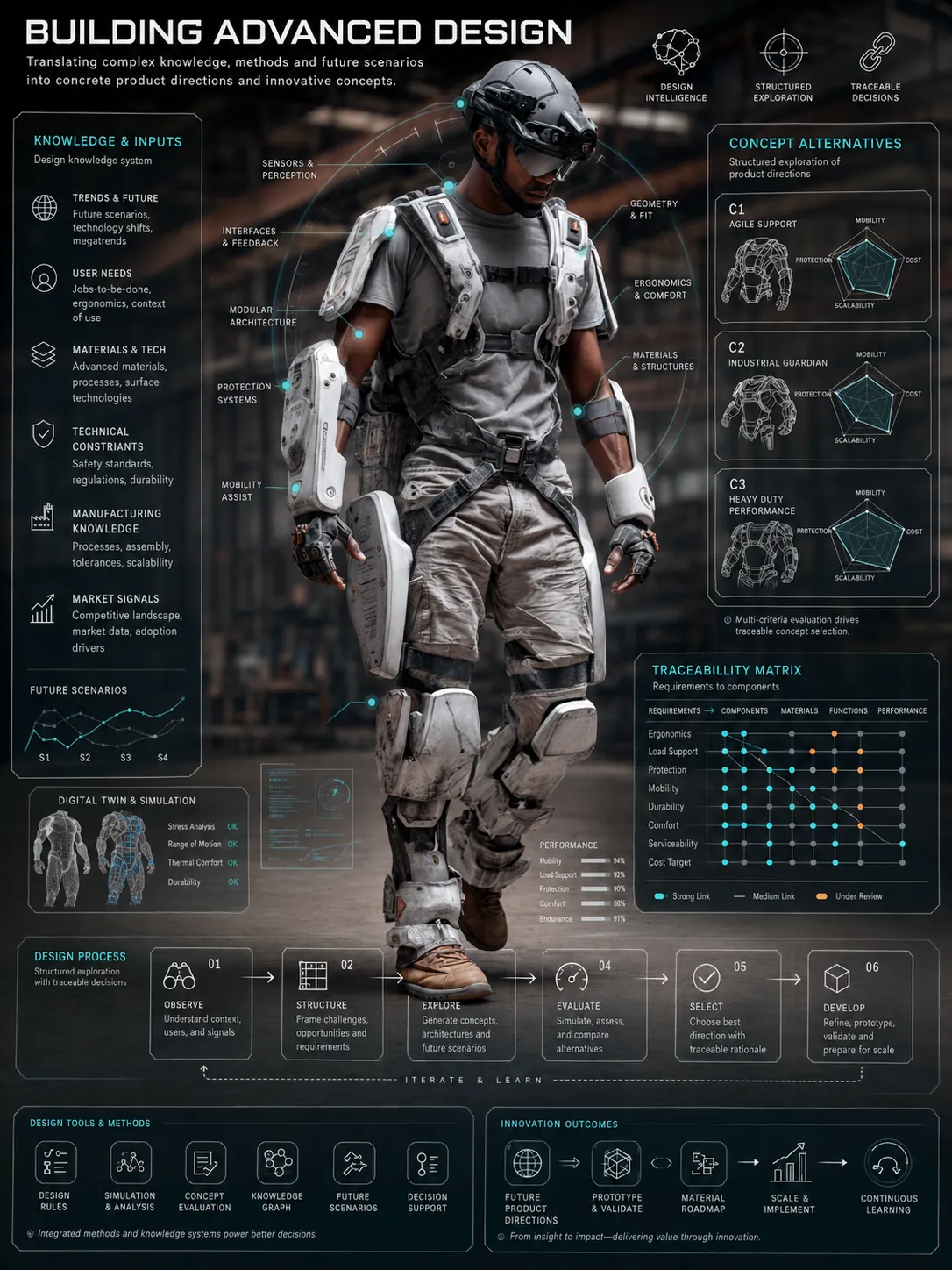
Building Advanced Design

These capabilities could increase the depth, variety and traceability of design exploration while supporting the development of design tools, methods and knowledge systems as well as translating complex information and future scenarios into concrete product directions and innovative concepts.

1_Research and Design Intelligence.

1.1

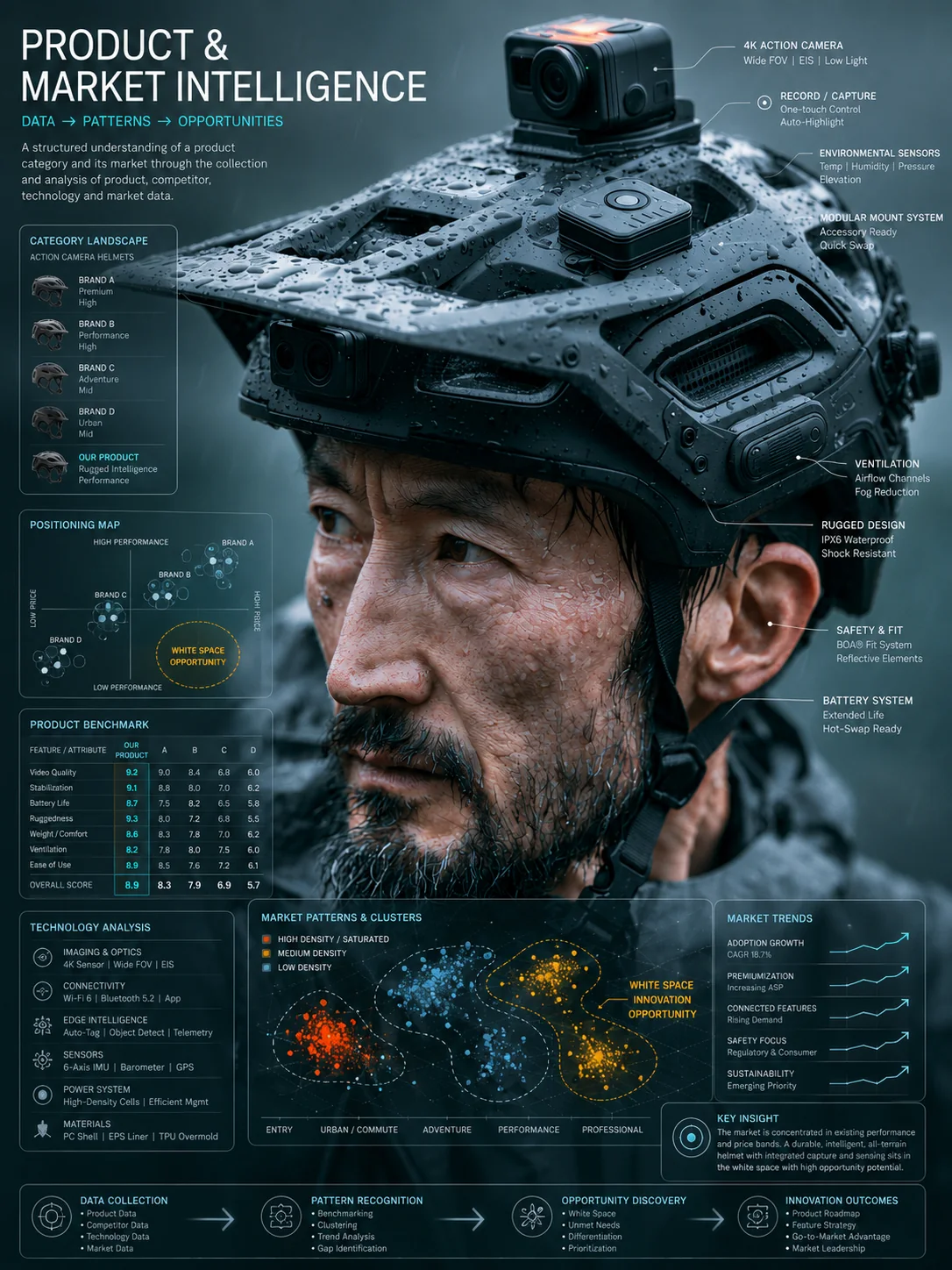
Target, Product and Market Intelligence

Within the framework, this capability serves a specific strategic purpose: to build a structured understanding of a market, product category or industrial sector through the collection and analysis of product, competitor, technology and market data. The objective is not simply to describe the existing market, but to identify recurring patterns, saturated areas, emerging directions and underexplored opportunities.

Main Outcomes

  • structured product, competitor and technology datasets;
  • competitive landscapes and positioning maps;
  • statistical analysis and product clustering;
  • product benchmarks and market visualisations;
  • identification of white spaces and innovation opportunities.

1.2

Product Structure and Systems Analysis

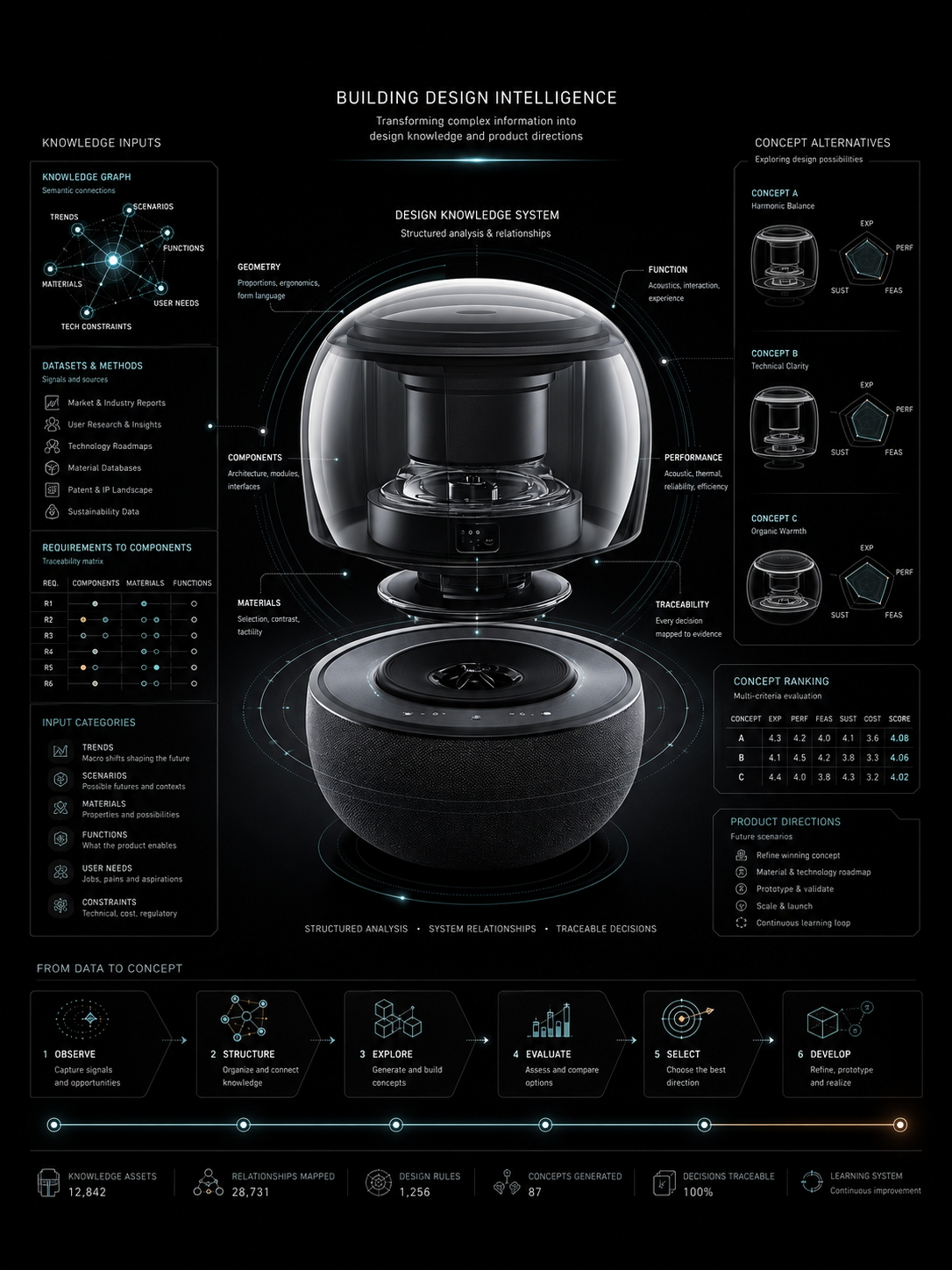
This capability contributes to the framework by helping to: analyse complex products as systems composed of parts, functions, materials, performances, constraints and relationships. This structured representation helps both designers and AI systems understand products beyond their external appearance. It can reveal critical dependencies, unnecessary complexity and new possibilities for reconfiguration.

Main Outcomes

  • functional and structural product decomposition;
  • relationships between parts, functions and users;
  • product knowledge graphs;
  • requirement, component and performance matrices;
  • structured product documentation for AI-supported design processes.

1.3

Social, Behavioural and Trend Analysis

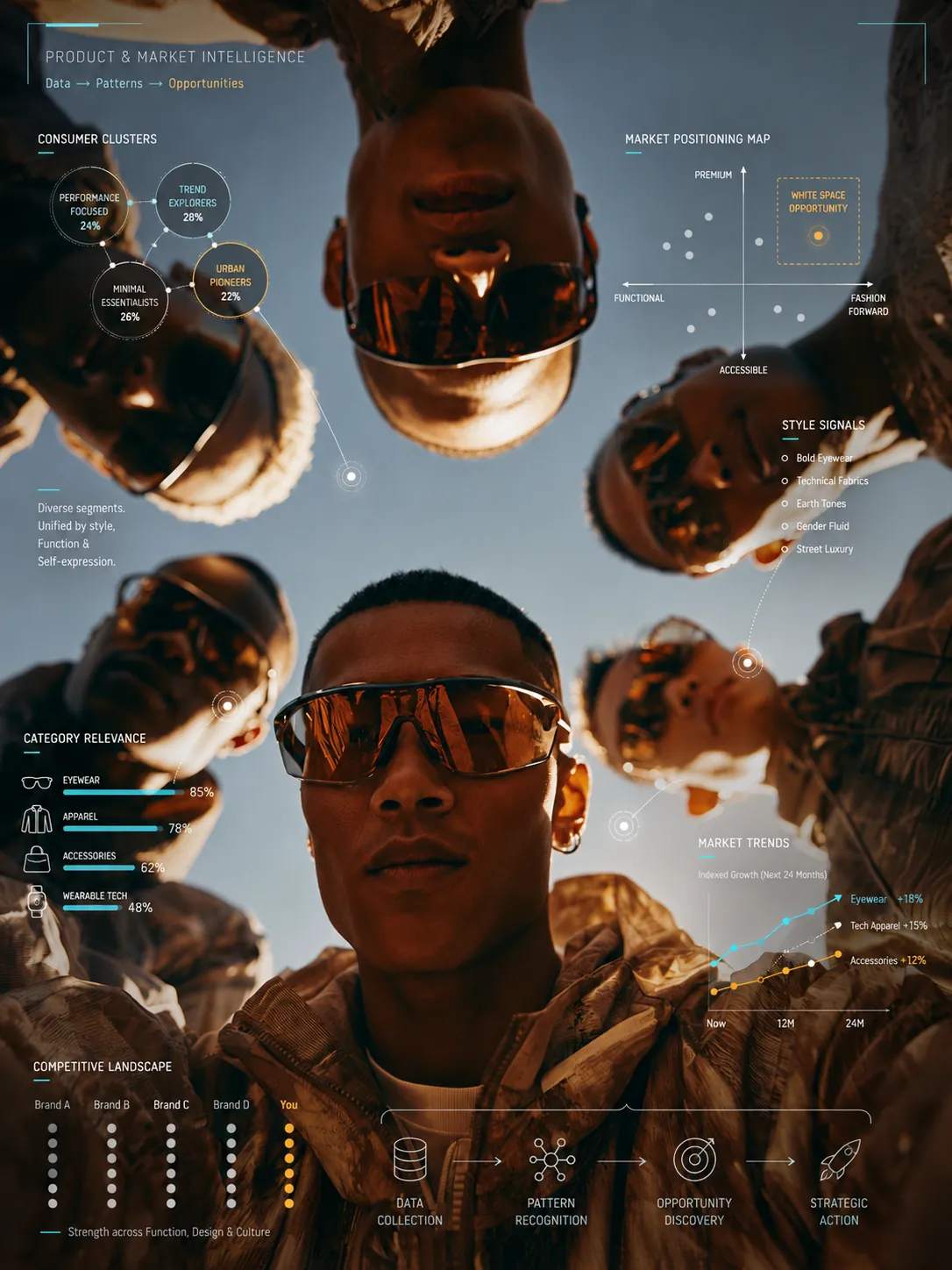
Within the framework, this capability serves a specific strategic purpose: to understand how social, cultural, demographic and behavioural changes may influence future products and services. The analysis can combine academic research, public data, digital content, user behaviours, cultural phenomena and emerging technologies. This allows design decisions to be based on observable transformations rather than intuition alone.

Main Outcomes

  • social and behavioural datasets;
  • trend and macrotrend maps;
  • identification of weak signals and emerging phenomena;
  • current and future user profiles;
  • visual connections between social change and product opportunities.

2_Foresight and Innovation Strategy.

2.1

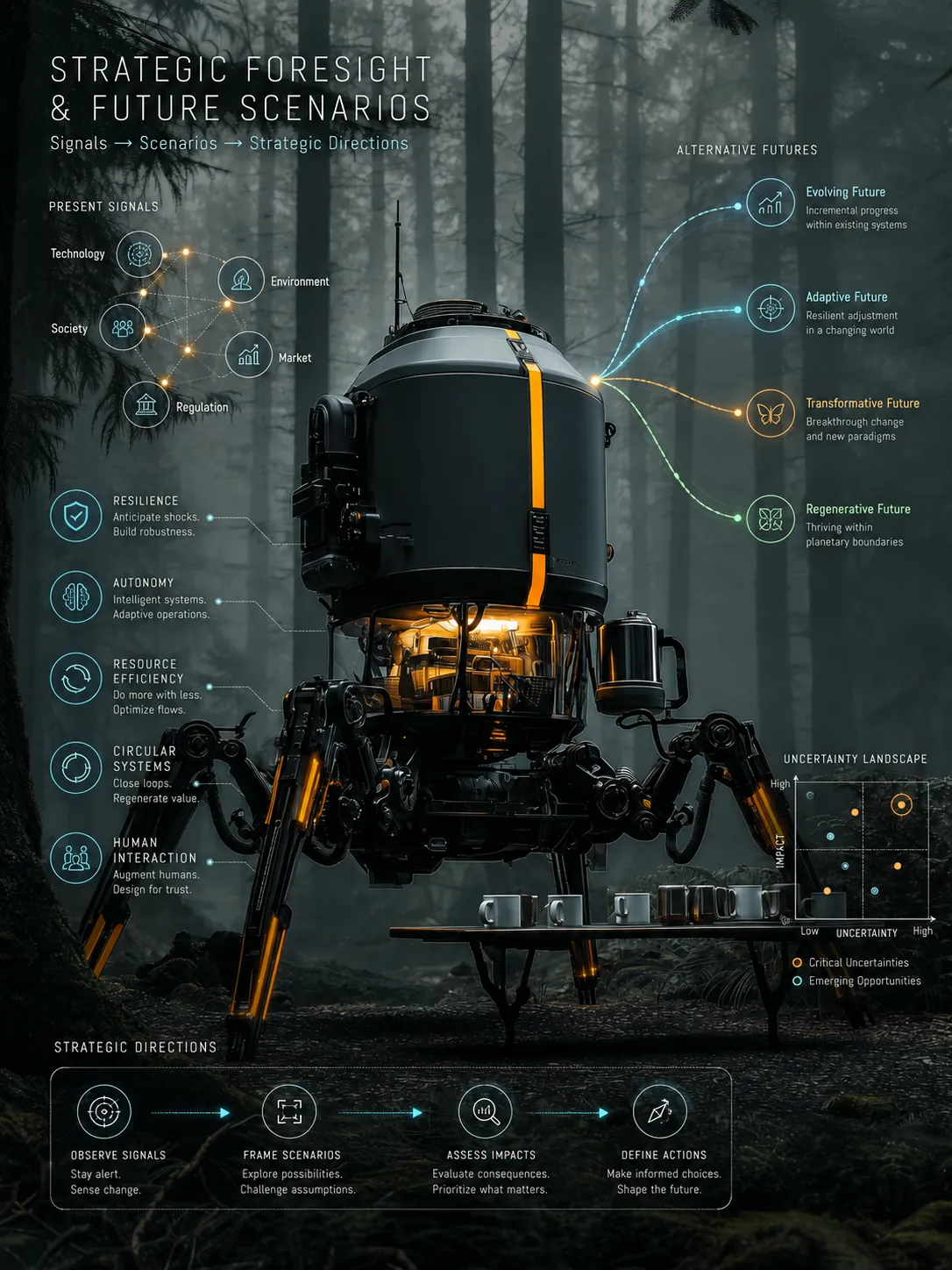
Strategic Foresight and Future Scenarios

This capability contributes to the framework by helping to: explore how markets, technologies, behaviours and product categories may evolve in the medium and long term.

Strategic foresight does not attempt to predict one single future. It develops several plausible scenarios based on drivers of change, uncertainties and emerging signals.

These scenarios help companies anticipate risks, prepare for change and identify opportunities before they become obvious.

Main Outcomes

  • drivers of change and strategic uncertainty maps;
  • alternative future scenarios;
  • future user profiles and customer journeys;
  • future product and service ecosystems;
  • strategic implications and development roadmaps.

2.2

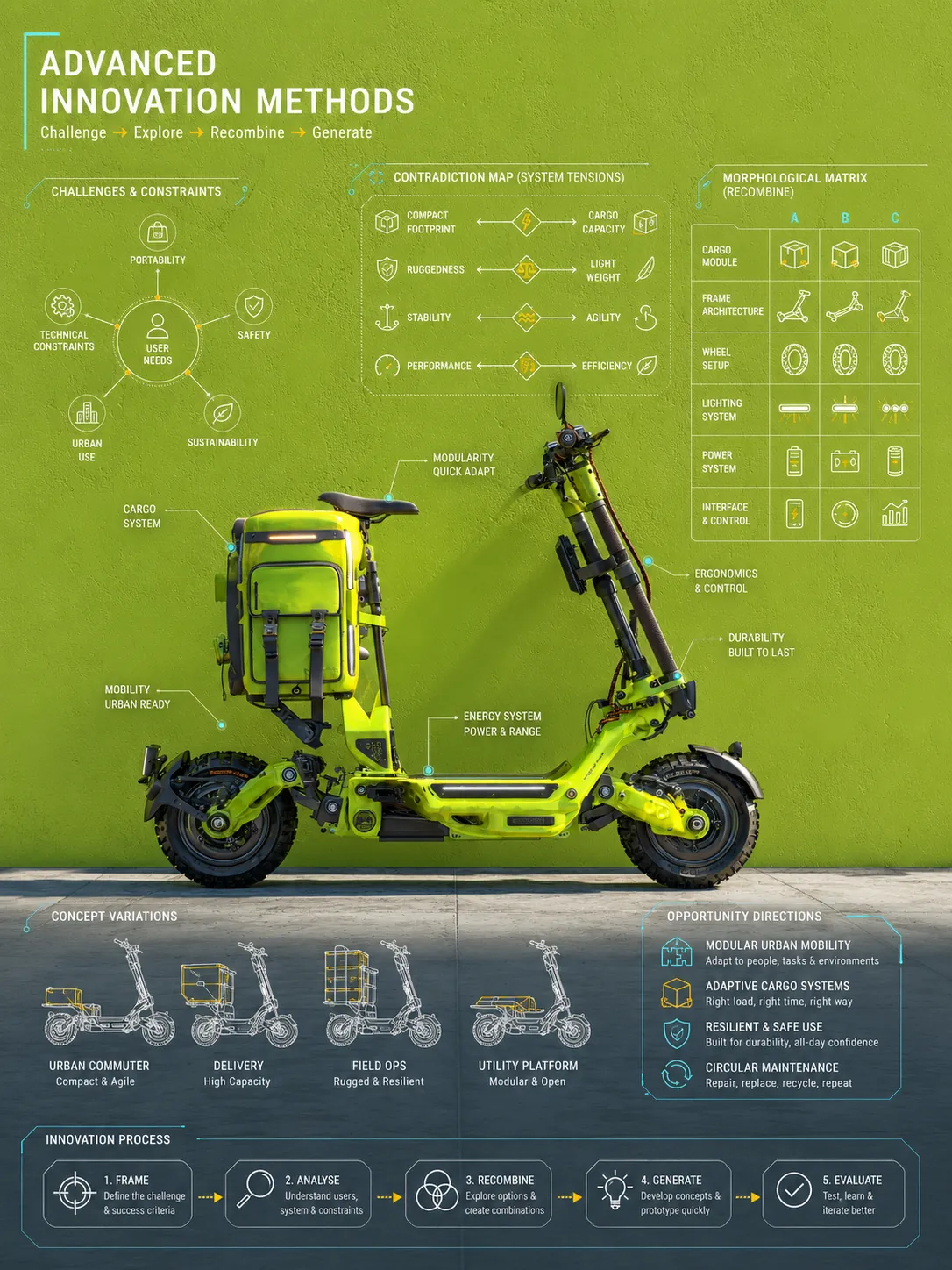
Advanced Innovation Methods

Within the framework, this capability serves a specific strategic purpose: to translate research, data and future scenarios into concrete areas of innovation.

The process may integrate TRIZ, contradiction analysis, morphological analysis, systems thinking, design heuristics and advanced problem-framing methods.

The aim is to make idea generation more systematic and to move beyond incremental variations of existing products.

Main Outcomes

  • innovation opportunity maps;
  • identification of unmet or emerging needs;
  • technical and user-related contradiction analysis;
  • morphological matrices and alternative configurations;
  • hypotheses for new product categories;
  • focused briefs for concept development.

2.3

Design Language Research

This capability contributes to the framework by helping to: analyse and develop product design languages aligned with a company identity, a market segment or a future scenario.

The research considers geometry, proportions, details, colours, materials, finishes, visual codes and product semantics.

It can help a company understand its current identity, compare it with competitors and define how its product language may evolve while remaining recognisable.

Main Outcomes

  • visual and product image datasets;
  • style and formal-language clustering;
  • semantic and competitive design maps;
  • design language principles;
  • colour, material and finish directions;
  • alternative future design language proposals.

3_Generative Design and Digital Tools.

3.1

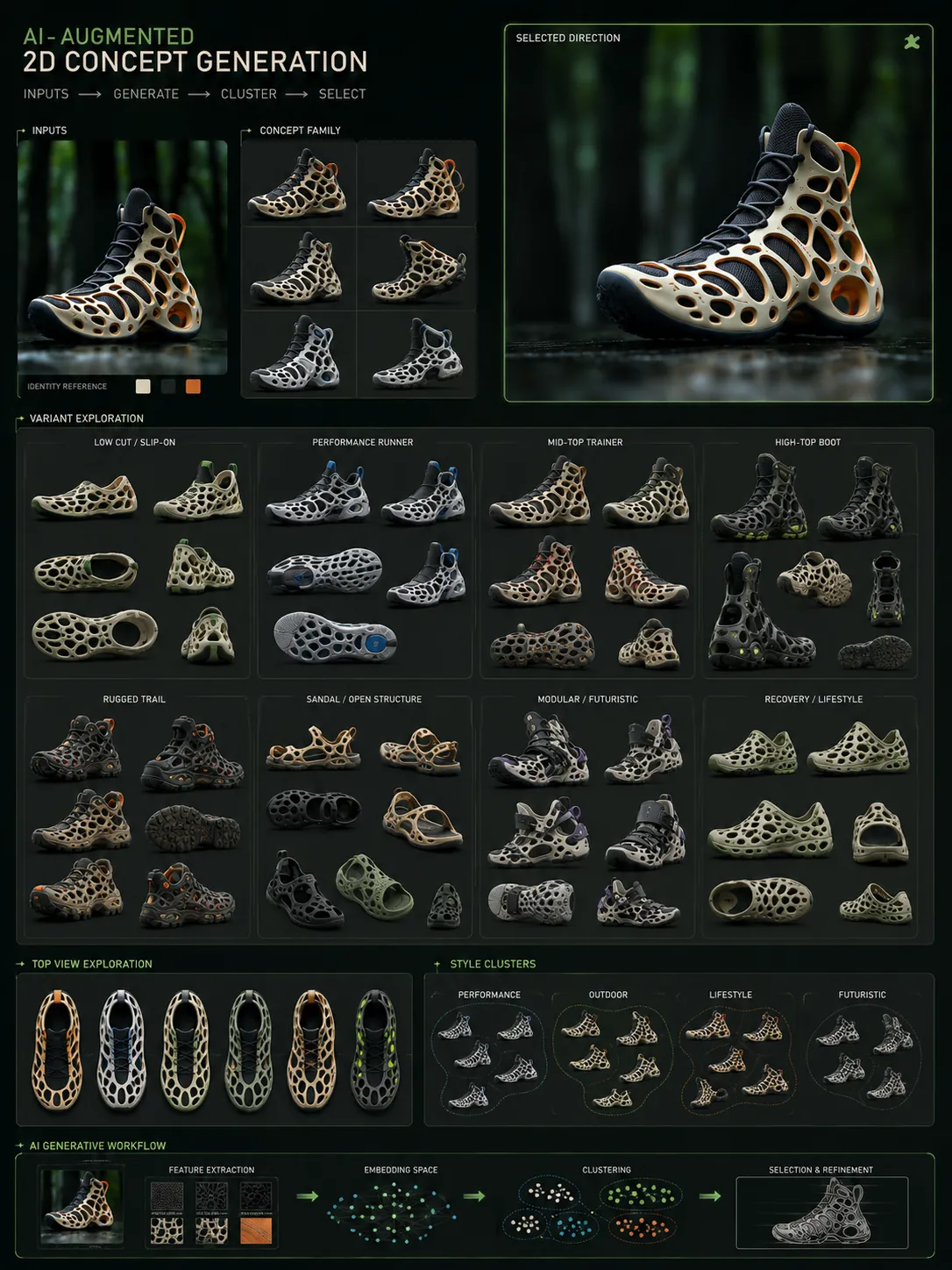
AI-Augmented 2D Concept Generation

Within the framework, this capability serves a specific strategic purpose: to explore a broad range of design possibilities through AI-supported processes directed and controlled by the designer.

AI is not used as a substitute for design, but as an exploratory tool operating within defined constraints, requirements, scenarios and design languages.

This makes it possible to generate, compare and refine a much larger number of coherent alternatives.

Main Outcomes

  • two-dimensional product concepts;
  • families of formal and functional alternatives;
  • concepts adapted to different users and scenarios;
  • visual applications of alternative design languages;
  • use scenarios and concept boards;
  • documented and traceable generative workflows.

3.2

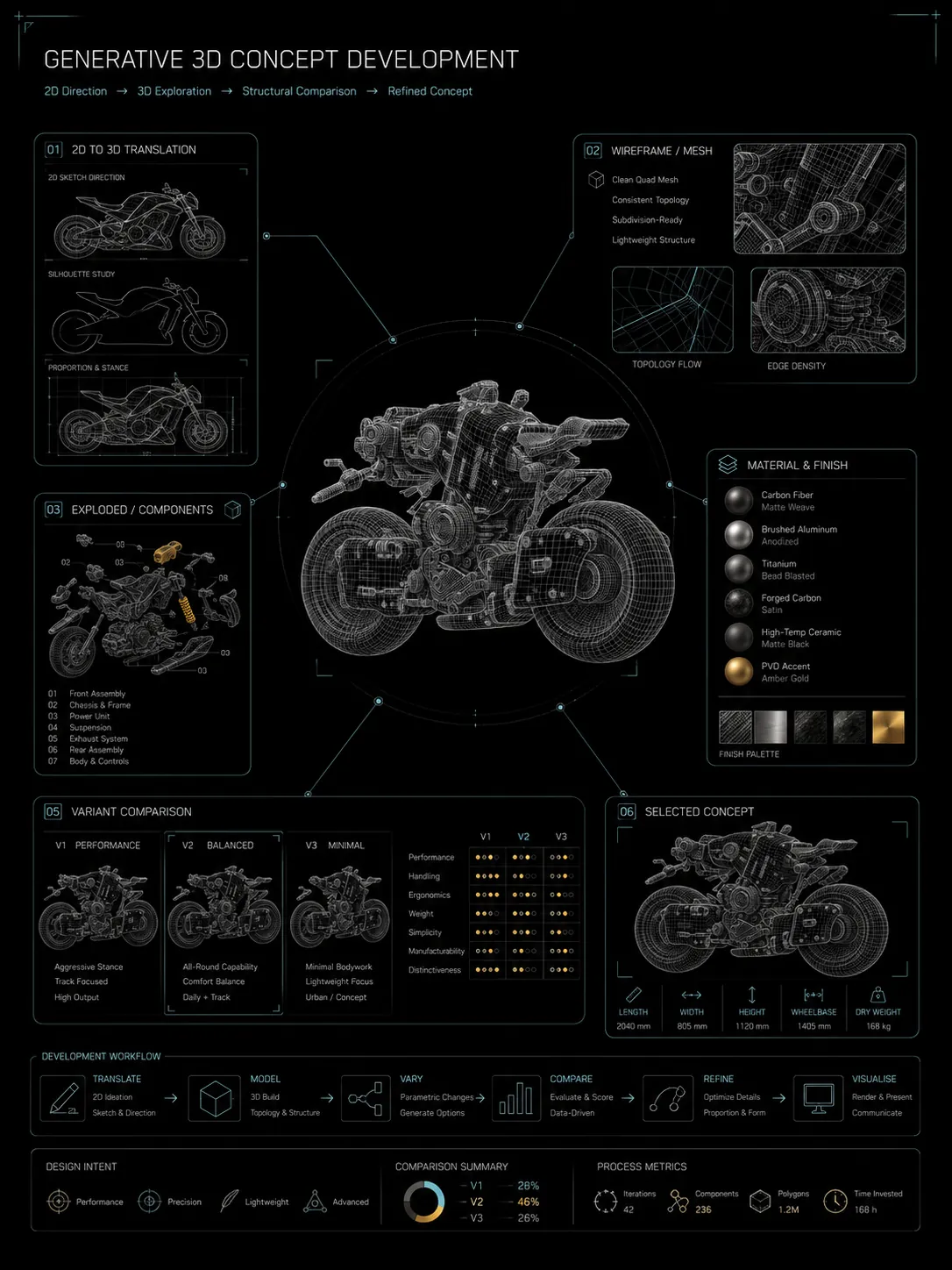
Generative 3D Concept Development

This capability contributes to the framework by helping to: transform selected directions into exploratory three-dimensional models that support the evaluation of proportions, volumes, configurations and relationships between components.

The process may combine traditional modelling, AI-assisted generation, mesh development, parametric systems and advanced visualisation.

The objective is to create a faster bridge between conceptual exploration and industrial development, without replacing detailed engineering or production CAD.

Main Outcomes

  • preliminary 3D concepts and mesh models;
  • geometric and configurational variations;
  • proportion and component studies;
  • material and finish explorations;
  • renders and contextual visualisations;
  • 3D models for further CAD development.

3.3

Custom AI Tools: design and evaluation

Within the framework, this capability serves a specific strategic purpose: to develop customised digital tools supporting research, design, evaluation and knowledge management.

These tools can organise complex information, guide the use of artificial intelligence, make advanced methods more accessible and improve the traceability of design decisions.

They may take the form of internal software, web interfaces, dashboards, structured prompt systems, knowledge bases or specialised AI assistants.

Main Outcomes

  • customised design and research tools;
  • HTML interfaces and interactive dashboards;
  • structured prompt systems and AI workflows;
  • project-specific datasets and knowledge bases;
  • concept evaluation and ranking systems;
  • traceable decision-support tools for designers, managers and clients.